 AquaSculpt
Berberine has spent two decades quietly building one of the most substantial human research files of any plant compound. It has been studied in randomized clinical trials, examined in systematic reviews, and compared head-to-head with metformin — one of the most widely prescribed medications in the world. And yet, outside of integrative medicine circles, most people still have never heard of it.
The interest comes from what berberine appears to do at a cellular level. It activates a protein called AMP-activated protein kinase, or AMPK — sometimes nicknamed the body's "metabolic master switch." When AMPK is active, cells tend to break down stored energy rather than store more. That single mechanism touches glucose handling, fat metabolism, cholesterol regulation, and several other systems involved in weight management. This article walks through what berberine is, what the published research actually shows, and where the honest limits sit.
What Berberine Is And Where It Comes From
Berberine is an isoquinoline alkaloid — a naturally occurring plant compound — found in the roots, bark, and stems of several traditional medicinal plants including barberry (Berberis vulgaris), goldenseal, Oregon grape, and Chinese goldthread (Coptis chinensis). It has a distinctive bright yellow color and a long history in traditional Chinese and Ayurvedic medicine, where it has been used for digestive complaints, infections, and metabolic disorders for centuries before any of these mechanisms were understood in modern scientific terms.
The modern research interest began in earnest in the early 2000s, when laboratory studies started identifying the molecular pathways berberine touches. Once researchers connected berberine to AMPK activation, the floodgates opened — because AMPK had already been identified as the same target that metformin, the leading first-line diabetes medication, also activates. The question naturally became: what does this plant alkaloid do in human trials?
The AMPK Connection: Why Researchers Call It The "Master Switch"
AMPK is a protein complex that exists in essentially every cell in the body. Its job is to monitor cellular energy status. When energy is low — which happens during exercise, fasting, or caloric restriction — AMPK becomes active and triggers a cascade of effects: cells start breaking down fats and glucose for energy rather than storing them, mitochondria become more efficient, and the body shifts into a more lipolytic ("fat-burning") state.
Compounds that activate AMPK without requiring exercise or fasting are interesting precisely because they mimic some of the metabolic signaling those activities produce. Berberine appears to be one of those compounds. A 2006 study in Diabetes demonstrated berberine's AMPK activation in cell and animal models, and follow-up human trials began testing whether the cellular effect translated to measurable clinical changes.
The Yin 2008 Trial: Berberine vs Metformin
One of the most-cited human trials on berberine was published in Metabolism in 2008 by Yin, Xing, and Ye. The pilot study tested berberine in patients with type 2 diabetes and compared it head-to-head with metformin over three months. Participants taking 500 milligrams of berberine three times daily showed reductions in fasting plasma glucose and hemoglobin A1c that were broadly comparable to those on metformin. Triglyceride and total cholesterol reductions were also observed in the berberine group.
This was not a definitive study — sample sizes were modest and the trial was not designed as a long-term outcome comparison — but it caught attention because it suggested a plant alkaloid was producing effects in the same general magnitude as a major prescription drug. Multiple subsequent trials and a 2022 meta-analysis pooling 37 studies and over 3,000 patients have largely supported the direction of the original findings, with most reviewers noting modest but consistent effects on fasting glucose and HbA1c.
Berberine has been studied in over 30 randomized controlled trials for metabolic markers including fasting glucose, HbA1c, and lipid profiles. While not a replacement for prescription medication, the research file is substantial enough that several integrative-medicine clinicians now consider berberine as a supportive option for adults working on metabolic health.
Glucose, Insulin, And The Carb Craving Cycle
Why does this matter for weight management? Because the same blood sugar and insulin signaling that berberine influences is also the engine behind one of the biggest derailers of well-intentioned weight management: carb cravings.
When blood sugar spikes and then crashes after a high-carbohydrate meal, the resulting dip drives the brain toward more easy, quick-burning food — exactly the kind that started the cycle. People who describe themselves as "always craving carbs" are often describing a glucose-insulin pattern, not a willpower failure. Compounds that support more stable post-meal glucose curves can quiet this cycle, which in turn makes everything else about sensible eating dramatically easier to sustain.
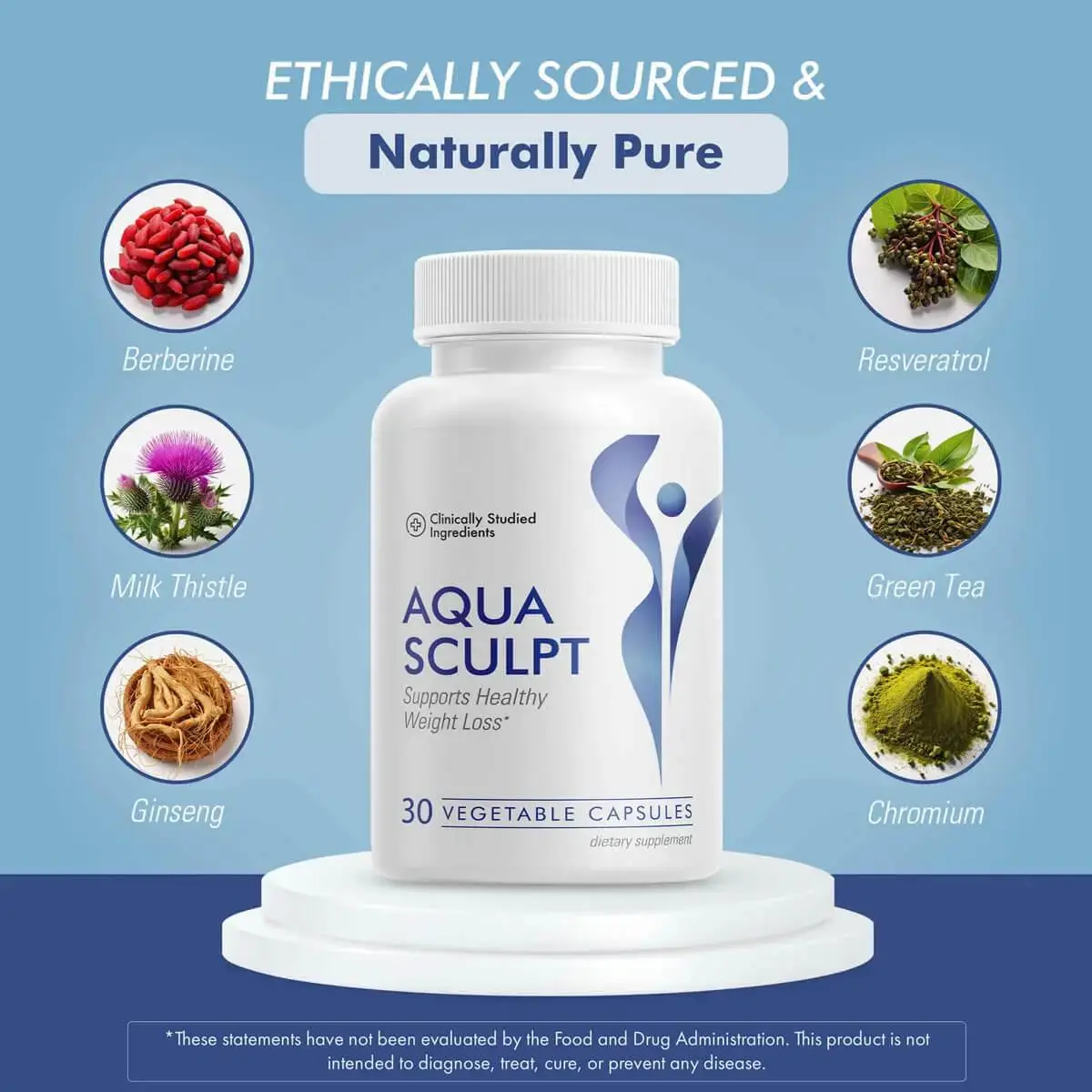
Berberine inside a complete formula
AquaSculpt combines berberine with five other clinically studied botanicals — Resveratrol, Green Tea EGCG, Milk Thistle, Korean Ginseng, and Chromium.
Realistic Dosage And Bioavailability
Most human trials with positive findings have used berberine at total daily doses of 900 to 1,500 milligrams, typically divided into two or three smaller doses taken with meals. Why with meals? Because berberine is poorly absorbed on an empty stomach — its bioavailability in animal models has been measured below 10 percent in some studies. Taking it with food, particularly food containing some fat, improves how much actually makes it through to the bloodstream.
Different formulations are available, and some manufacturers pair berberine with absorption enhancers like silymarin (from milk thistle) precisely because the combination has been shown to improve berberine's bioavailability. Stand-alone berberine supplements are widely available, although consumers should look for products with transparent dosing and third-party testing.
Side Effects And Who Should Avoid It
The most common side effect of berberine is mild gastrointestinal discomfort — bloating, gas, or loose stools — typically in the first week of use as the gut adapts. This usually resolves on its own. Less common reports include headaches and mild constipation.
Several groups should not take berberine without specifically discussing it with their physician:
- Pregnant or nursing women — berberine has not been adequately studied in these populations and there are theoretical concerns about effects on neonates.
- People taking prescription diabetes medication — combining berberine with insulin sensitizers or other glucose-lowering drugs can produce hypoglycemia and requires medical monitoring.
- People taking certain antibiotics or anticoagulants — berberine interacts with the same liver enzymes (particularly CYP3A4) that metabolize many medications.
- People with active liver or kidney disease — same reason.
Stacking Berberine With Other Botanicals
Berberine on its own targets the glucose-AMPK axis well. But weight management is rarely a single-pathway problem. Most people contending with weight gain have at least three things happening simultaneously: stable glucose handling is one piece, but appetite regulation, energy levels, cellular antioxidant defense, and sleep quality all influence the bigger picture too.
This is why berberine is often seen in formulations alongside complementary botanicals. Green tea extract (EGCG) targets fat oxidation through a different pathway. Chromium supports insulin sensitivity from a different angle. Milk thistle (silymarin) both supports liver function and improves berberine absorption. Resveratrol touches mitochondrial and longevity pathways. A well-designed multi-ingredient formula can engage several levers at once where a single ingredient would only address one.
Bottom Line For Weight Management
Berberine is not a weight loss drug. It is a botanical with a substantial human research file behind it, primarily focused on glucose metabolism, AMPK signaling, and lipid markers. The downstream effects on weight management are indirect but real — stabilized glucose responses tend to reduce the carb craving cycle, and AMPK activation supports the metabolic conditions in which sensible eating habits actually start producing results.
If you are considering berberine, look for it inside a thoughtfully formulated product that combines it with complementary botanicals, taken at a sensible daily dose with food. Pair it with the basics — adequate sleep, real food, consistent movement, and ideally a routine that includes the daily cold water habit covered in our companion piece. Berberine is one of the more interesting plant compounds the modern research file has identified. Used realistically, it can be a meaningful piece of a wider approach.
Scientific References
1. Yin J, Xing H, Ye J. "Efficacy of berberine in patients with type 2 diabetes mellitus." Metabolism. 2008;57(5):712–717. PMID: 18442638
2. Lee YS, Kim WS, Kim KH, et al. "Berberine, a natural plant product, activates AMP-activated protein kinase with beneficial metabolic effects in diabetic and insulin-resistant states." Diabetes. 2006;55(8):2256-2264.
3. Xie W, Su F, Wang G, et al. "Glucose-lowering effect of berberine on type 2 diabetes: A systematic review and meta-analysis." 2022.
Ready To Try The Ice Water Ritual?
AquaSculpt pairs the principles you just read about with six clinically studied botanicals, in one vegetable capsule taken daily with cold water. Backed by a 180-day money-back guarantee.
See AquaSculpt Pricing →