 AquaSculpt
A claim has been circulating on wellness sites and social media for over a decade: drinking cold water boosts metabolism enough to meaningfully impact weight loss. The version most people have heard goes something like, "your body burns calories just to warm the water up." It sounds intuitive enough that millions of people now incorporate cold water into their morning routine for that exact reason.
Here is the honest answer, based on what the published research actually measured. Yes, drinking water — particularly cold water — does produce a measurable metabolic response. No, that response on its own is not large enough to be a standalone weight loss strategy. But the effect is real, repeatable, and worth understanding, because the people who use it most effectively are layering it with other small habits that add up. This article walks through what the science actually shows, where the popular narrative gets it right, where it gets it wrong, and how to use cold water sensibly as one piece of a wider approach.
What Water-Induced Thermogenesis Actually Is
"Thermogenesis" is just the scientific word for heat production. Your body is constantly generating heat as a byproduct of metabolism — that is why your core temperature sits around 98.6°F (37°C) regardless of the room temperature. When you ingest something cooler than your core temperature, your body uses additional energy to bring it up to internal body heat. This is the simple part most people already understand.
The less-understood part is that water also activates what researchers call osmosensitive mechanisms — receptors that respond to changes in the fluid balance in your body. When you drink a large glass of water, you are not just adding fluid; you are briefly changing the salt concentration of the blood that flows past these receptors. Some of the metabolic response to water drinking appears to come from this signal, not just from the temperature warming. This was an important finding because it suggested water itself has a metabolic effect, regardless of whether it is cold or room temperature, although cold water still produces a larger total response.
The 2003 Boschmann Study: Where The Number Comes From
Most claims you see online about water and metabolism trace back to a single, well-known study published in the Journal of Clinical Endocrinology & Metabolism in December 2003. Researchers led by Michael Boschmann at the Franz Volhard Clinical Research Center in Berlin measured what happened to resting metabolic rate after 14 healthy adults each drank 500 milliliters (about 17 ounces) of water. The participants were placed in a whole-room calorimeter — a sealed chamber that measures every calorie burned with extreme precision.
The findings were striking. After drinking the water, the participants' metabolic rate increased by approximately 30 percent, the effect started within ten minutes, and it peaked around 30 to 40 minutes later. The team estimated that drinking an additional 1.5 liters of water per day could lead to an extra 200 kilojoules (about 48 calories) of daily energy expenditure beyond baseline. Importantly, the study also found that drinking the water cold (room temperature, around 22°C) produced approximately 40 percent more thermogenic effect than drinking it at body temperature — because of the additional energy required to warm it.
A follow-up Boschmann study published in 2007 reproduced the effect in overweight subjects, with a 24 percent increase in energy expenditure over 60 minutes after drinking 500 ml of water. So the effect is not just a quirk of normal-weight bodies.
How Cold Does Cold Water Need To Be?
This is where the popular narrative often runs ahead of the science. The 2003 Boschmann study used water at room temperature, not ice cold. A separate 2006 study reanalyzed the question and tried 3°C ice water; it found a smaller increase than the math would predict, because the body's thermoregulation is actually pretty efficient at managing temperature without wasting calories the way some "ice water hack" content implies.
Here is the realistic picture. Cold water — meaning genuinely cold, refrigerated, or with a few ice cubes — appears to produce more thermogenic effect than warm water. The colder, the more energy needed to warm it. But the effect is bounded by the body's actual heat-management physiology, and at some point colder does not add proportionally more burn. Most practical advice settles on water at standard refrigerator temperature, around 4–7°C, which produces a noticeable thermogenic response without the discomfort of trying to chug ice slush.
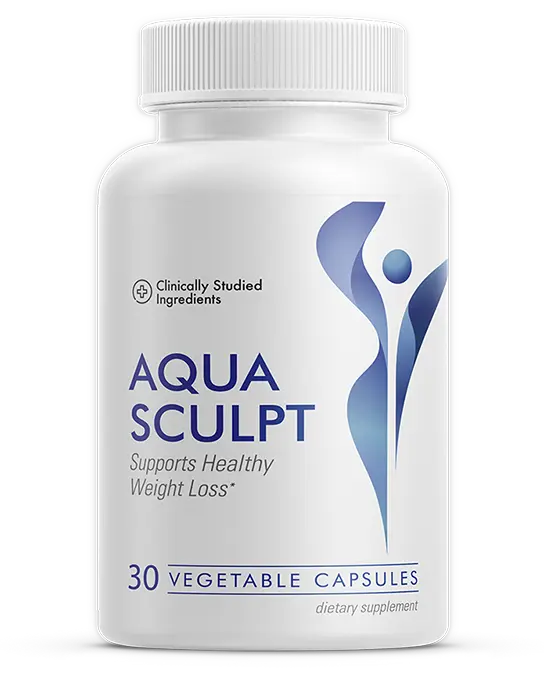
A daily ritual built around this principle
AquaSculpt pairs the cold water response with six clinically studied botanicals — one vegetable capsule daily, 180-day guarantee.
The 24-Hour Math: Does It Actually Move The Scale?
Let us be honest about the size of the effect. Based on the Boschmann numbers, drinking 2 liters of cold water spread across a day produces roughly 80 to 100 extra calories of energy expenditure compared to no water intake at all. That is not nothing — 100 calories per day, over a year, is about 36,500 calories, or roughly 10 pounds of fat equivalent — but it is also not the dramatic transformation some marketing makes it sound like. Most importantly, that math assumes you would otherwise drink zero water, which is unrealistic.
So what is the real picture? If you currently drink about a liter of water per day and you increase that to two liters of cold water spread across the day, the additional thermogenic effect is probably in the range of 40 to 60 calories. Over a year that could add up to several pounds of fat loss, all else being equal. It is a tailwind, not a transformation.
Why The Habit Might Still Be Worth Building
The thermogenic math, by itself, is modest. But several indirect benefits compound the direct effect:
- Appetite reduction. A 2010 study in the journal Obesity found that drinking 500 ml of water before meals reduced calorie intake at that meal by an average of about 75 calories in adults aged 55-75. Across three meals, that is more than the direct thermogenic effect.
- Replaces caloric beverages. If a glass of cold water replaces a 150-calorie soft drink or a sugar-laden coffee, the net swing is far larger than the thermogenic effect alone.
- Improves the absorption window of any supplement taken with it. This is why supplement protocols often pair the daily dose with a glass of cold water — the timing helps establish a routine, and water improves the dissolution of capsule contents.
- Anchors a morning routine. Behavioral research consistently shows that small, easily-completed morning rituals — even ones with modest direct effects — anchor more substantial behavior change throughout the day.
How To Use Cold Water Sensibly
If you want to fold this into a real daily approach, here is what the published research and clinical practice broadly support:
- Start the day with a 10 to 12 ounce glass of cold water before coffee or food. This sets the metabolic tone and supports hydration after the overnight fast.
- Drink another large glass roughly 30 minutes before each main meal — this is the timing most strongly associated with appetite reduction.
- Aim for 2 to 2.5 liters total per day for most healthy adults, more if you exercise heavily or are in hot weather.
- Cold or refrigerator-cool is fine — you do not need ice cubes for the effect, although you can use them if you prefer.
- Pair the morning glass with anything else you want to make habitual — a brief stretch, a one-line journal, or a daily wellness supplement. The combination strengthens the routine.
Honest Limits And Cautions
A few caveats matter. You can drink too much water — water intoxication (hyponatremia) is rare in normal life but real, and is more common in endurance athletes who drink large volumes without replacing sodium. For most healthy adults, 2 to 3 liters per day across hours is safely within range. People with kidney conditions, heart failure, or those on certain medications should follow their physician's guidance on fluid intake rather than any general advice.
And the meta-point: cold water is not a weight loss strategy on its own. It is a small, reliable, almost-free behavioral tailwind that compounds with the rest of what you do. The people who get the most from it are the ones who use it as the anchor of a wider approach — sleep, real food, consistent movement, and where appropriate, supportive supplementation that targets the metabolic pathways the cold water response touches.
Final Thoughts
The "ice water hack" gets dismissed by skeptics and oversold by influencers in equal measure. The truth sits between. Drinking cold water produces a real, measurable metabolic response — modest in size, but free, sustainable, and easy to build into daily life. It will not move the scale on its own. But as the foundation of a daily routine — particularly one that pairs it with supportive nutrition and clinically studied botanicals — it can be a quiet, dependable tailwind for healthy weight management.
Scientific References
1. Boschmann M, Steiniger J, Hille U, et al. "Water-induced thermogenesis." J Clin Endocrinol Metab. 2003;88(12):6015–6019. PMID: 14671205
2. Boschmann M, Steiniger J, Franke G, et al. "Water drinking induces thermogenesis through osmosensitive mechanisms." J Clin Endocrinol Metab. 2007;92(8):3334–3337. PMID: 17519319
3. Dennis EA, Dengo AL, Comber DL, et al. "Water consumption increases weight loss during a hypocaloric diet intervention in middle-aged and older adults." Obesity. 2010;18(2):300-307.
Ready To Try The Ice Water Ritual?
AquaSculpt pairs the principles you just read about with six clinically studied botanicals, in one vegetable capsule taken daily with cold water. Backed by a 180-day money-back guarantee.
See AquaSculpt Pricing →